By A. H. KOSCHMANN and M. H. BERGENDAHL - USGS 1968
Click here for the Principle Gold Producing Districts of the United States Index
Gold, the lure that drew settlers across the wide prairies and into the most remote mountain gullies in our Western States, proved also to be the dominant factor in the settlement of Alaska. This most important mineral commodity of the State was known in Alaska as early as 1848, long before the territory was acquired from Russia by the United States in 1867.
P. P. Doroshin, a Russian mining engineer, made the discovery in the gravels of the Kenai River on the Kenai Peninsula, but there was no great excitement and apparently no gold was mined (Martin and others, 1915, p. 181-182). A second discovery of placer gold in 1865-66 on the Seward Peninsula by a party exploring for a telegraph route similarly failed to arouse much interest (Collier and others, 1908, p. 13-14).
Alaskan gold mining began in southeast Alaska. In 1869 miners who had been disappointed in the Cassiar gold district in British Columbia discovered gold placers at Windham Bay and Sumdum Bay southeast of Juneau. In 1870-71 the first gold produced in Alaska, reported to be worth $40,000, was extracted from these placers (Wright, 1906, p. 2).
At about this time the first attempts to mine lode gold were made near Sitka (Knopf, 1912, p. 8). In the early 1870's extensive copper deposits were found on Prince of Wales Island, but because of the remoteness of the area from transportation facilities, these were not developed for many years. The major lode gold deposits of Alaska were found in 1880 at Juneau, and by 1883 Juneau was the mining center of the territory (Wright, 1906, p. 3).
Encouraged by the successes at Juneau, the prospectors spread through southern Alaska and made important gold discoveries at Berners Bay and Eagle River on the mainland near Juneau, at Klag Bay on Chichagof Island, at Willow Creek near Anchorage, and even on far-off Unga Island, 1,000 miles to the west.
Numerous gold districts, the most important of which are Nome, Council, and Fairhaven, are on the Seward Peninsula. This region was prospected first by gold seekers drawn north by the great Klondike (Yukon Territory, Canada) rush of 1897-98. By 1898 the discovery of the rich Nome placers triggered a stampede to the new area and led to the rapid development of the entire peninsula. Nome, the second largest gold-producing district in Alaska, was active until 1962.
As transportation facilities improved after 1900, new gold discoveries were made in the more remote areas, and previously known deposits were developed and mined. This activity extended into the 1930's, and several lode and placer districts in the Yukon basin were activated in this interval.
Gold mining in Alaska was seriously affected in 1943 by the imposition of War Production Board Order L-208 which closed nearly all of the gold mines during World War II (fig. 4). After the war the placer mines of the Fairbanks district resumed large-scale operations, and this single district accounted for more than half the total annual gold production for Alaska during 1950-65. The lode mines in Alaska were virtually inactive during 1942-65.
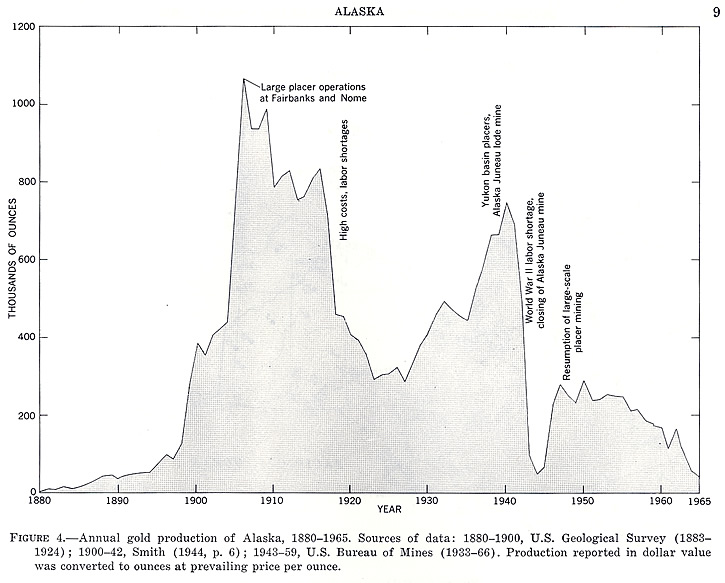
Of the total value of $722,122,186 of gold (28,859,718 ounces) produced in Alaska from 1880 to 1957, $504,076,577 came from placer mines (U.S. Bureau of Mines, 1957, p. 83, 85). During 1958-59 the gold production amounted to 365,353 ounces, most of which came from placers (U.S. Bureau of Mines, 1959, p. 84).
Most of the lode gold has come from the Juneau district in southeast Alaska, and an unknown but probably small amount has been produced as a byproduct of copper ores in the Prince William Sound region. The gold production of Alaska before 1880 is unknown, but probably was not great.
Emmons (1937, p. 203) discussed the general relationships of gold deposits to geology. He pointed out that the chief lode deposits are associated with Mesozoic granite that have intruded rocks of Pre-cambrian, Paleozoic, and Mesozoic ages. This belt of intrusives extends from the Seward Peninsula to the Yukon Territory.
The lode deposit on Unga Island in the Aleutian Islands is in Tertiary ande-site. The placer deposits are widespread, occurring along nearly all the major rivers and their tributaries, and even in beach sands in the Nome area, on Kodiak Island, Yakataga, Lituya Bay, and Cook Inlet.
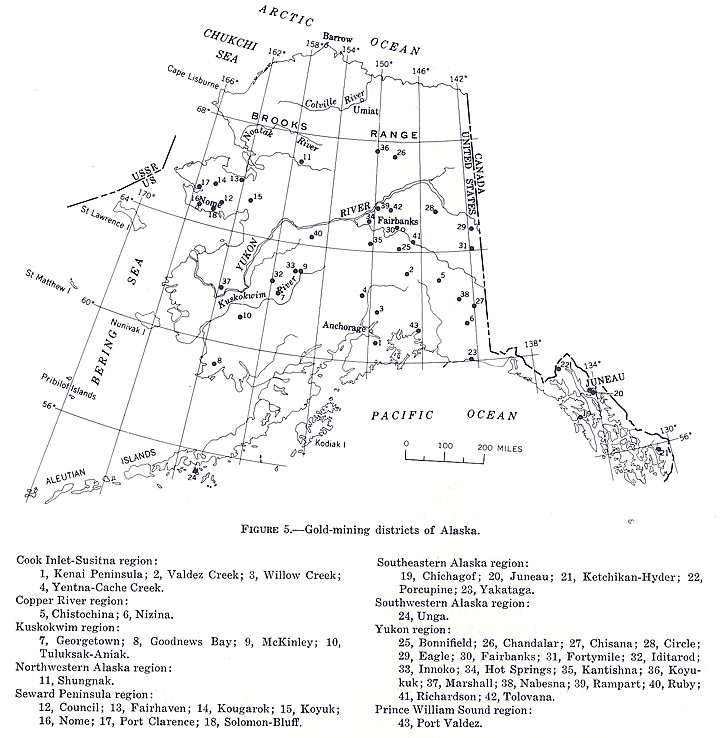
As in earlier reports of the Geological Survey (for instance, Smith, 1939), the State is subdivided into nine geographical regions: Cook Inlet-Susitna, Copper River, Kuskokwim, Northwestern, Seward Peninsula, Southeastern, Southwestern, Yukon, and Prince William Sound. The regions and the individual districts (fig. 5) within the regions are discussed in this report.
The vast Yukon drainage basin has produced more gold than any other region in Alaska, even though it was the most recent of the gold-producing regions to be exploited. With transportation virtually limited to river travel, the great distances from gold deposits to supply and population centers inhibited any large-scale mining in the early days.
The first gold discoveries were made in 1878 (Mertie, 1937, p. 4) ; however, tales of gold had been circulated years earlier by traders and trappers who set up posts at various points along the Yukon River. Smith (1933, table facing p. 96) listed the earliest production for this region in 1883 from the Fortymile district.
The important placers at Fairbanks were discovered in 1902, and by 1910 lode mines were active in this district. The Fairbanks placers proved amenable to large-scale dredging operations, which soon made this district the largest gold producer in Alaska.